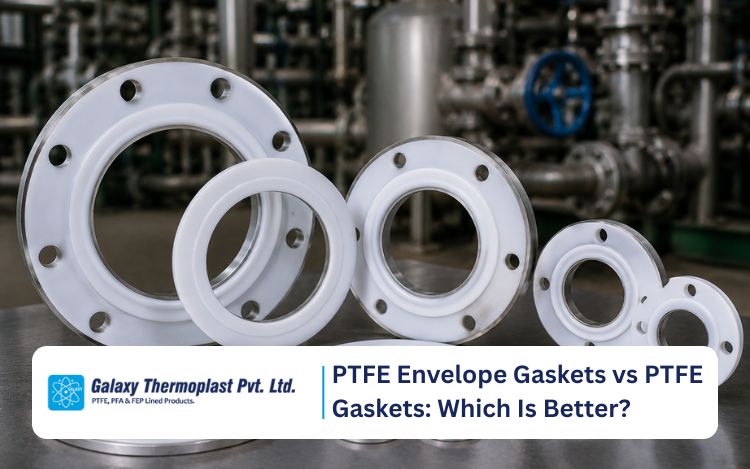
Polytetrafluoroethylene (PTFE) is a premier material choice for industrial gaskets because of its exceptional chemical resistance, wide temperature thresholds and non-stick surface qualities. In complex fluid handling situations, engineers typically have two design options: PTFE Envelope Gaskets & Full PTFE Gaskets Structural variations between the two alternatives greatly effect seal integrity, installation safety and project finances. The optimum variation should be selected based on an assessment of the individual factors of your specific pipe application.
What Are PTFE Envelope Gaskets?
PTFE envelope gaskets are split composite. A pure PTFE “jacket” in contact with process fluids protects an inner core filling. The internal filler layer of compressed asbestos fiber (CAF), compressed non-asbestos fiber (CNAF), rubber elastomeric parts or corrugated stainless steel inserts gives structural memory and mechanical rigidity.
Industrial operators deploy envelope styles across glass-lined piping networks, pharmaceutical production loops, food manufacturing, and aggressive chemical processing plants.
Key Benefits:
- Exceptional defensive resistance to harsh corrosive chemicals.
- Significantly more economical than heavy solid PTFE alternatives.
- Enhanced mechanical resistance and structural memory provided by the internal core.
- Low seating stress requirements, making them ideal for large-diameter glass or alloy flanges.
What Are Full PTFE Gaskets?
Full PTFE gaskets are manufactured entirely from a single, homogeneous matrix of virgin or expanded PTFE without any internal metal or fiber inserts. Because they maintain uniform material composition throughout, there is zero risk of a process fluid penetrating an outer jacket and attacking an incompatible interior filler. They are the standard choice for lines routing ultra-pure fluids or aggressively corrosive media that rapidly disintegrate standard sealing materials.
Key Benefits:
- Maximum comprehensive chemical compatibility across the full pH spectrum (0–14).
- Completely contamination-free sealing, ensuring the absolute highest purity levels.
- Optimal performance within demanding pharmaceutical systems and FDA-regulated food processing facilities.
- Elimination of localized leakage points common in composite variants.
Difference Between PTFE Envelope Gaskets and Full PTFE Gaskets
| Feature | PTFE Envelope Gaskets | Full PTFE Gaskets |
| Construction | Protective PTFE outer jacket with internal filler core | Single piece made entirely from premium PTFE matrix |
| Cost Profile | Highly economical, especially in larger dimensions | Higher baseline cost due to complete material volume |
| Mechanical Strength | Superior mechanical rigidity via the insert material | Lower; prone to cold flow or creep without modifiers |
| Chemical Resistance | Excellent protection over a wide range of process media | Superior; absolute uncompromised chemical inertness |
| Purity Level | Good; safe for standard food and medicine loops | Highest purity; completely clean for critical batches |
| Compressibility | Yields reliable sealing even under lower bolt loads | Demands highly precise torque and bolt loading |
| Large Diameters | Highly suitable for extensive or irregular piping layouts | Less cost-effective for large-diameter flanges |
| Service Life | Good; stable under constant operational pressure | Excellent within highly aggressive, pure chemical environments |
| Food & Pharma Use | Fully compliant and widely acceptable | Highly preferred for sterile, zero-contamination systems |
| Customization | Offers diverse core material tuning options | Limited strictly to standard PTFE raw material grades |
When Should You Choose PTFE Envelope Gaskets?
PTFE envelope gaskets are a good option when solid plastic rings become cost prohibitive for big diameter flange systems. They will perform well in moderate pressure applications and delicate arrangements such as glass-lined tanks and plastic piping systems, which cannot take heavy bolt loads. Envelope patterns provide the finest structural balance for heat cycling with no big investment.
When Should You Choose Full PTFE Gaskets?
Processing areas with aggressive chemical flows, strong acids, or volatile solvents require these full PTFE gaskets. Their purity prevents the batch contamination in ultra-pure pharmaceutical manufacturing and automated food-grade systems. Choose solid or expanded configurations when your piping must handle unforgiving corrosive service without risking structural degradation or inner filler exposure.
Conclusion
Neither design is better in all respects, yet each configuration is useful for a certain purpose in current fluid dynamics. PTFE envelope gaskets offer the proven combination of mechanical strength, dependable sealing and reasonable price. Conversely, PTFE in its entirety offers superior chemical resistance and sterile purity. You have to analyze the operating pressures, fluid compatibility and total system budget to choose the right version.

